Once a festival I feared, Thaipusam is now one I deeply respect. On 1 February 2026, this sacred Hindu tradition will fill Singapore’s streets with devotion and vibrant rituals. Here’s what you need to know to witness it along the four-kilometre route from Serangoon Road to Tank Road.
I have to come clean! Growing up, Thaipusam always seemed like a terrifying festival to me. I remember the crowds, the intense noise, and the sight of devotees piercing their skin with metal skewers and carrying heavy kavadis. It was a tradition I couldn’t quite understand, leaving me uneasy. However, my perspective completely changed as I learned more about its significance and the deep spiritual meaning behind the rituals. Thaipusam became something I can appreciate and respect today rather than fear.
Is Thaipusam a public holiday in Singapore?
Thaipusam is not a public holiday in Singapore. That said, the Hindu Thanksgiving festival of Thaipusam is of cultural significance to the Tamil Hindu community in Singapore. Thaipusam 2026 will be celebrated on Sunday, 1 February 2026. Devotees will walk a four-kilometre procession from the Sri Srinivasa Perumal Temple on Serangoon Road to the Sri Thendayuthapani Temple on Tank Road, with the sound of live music accompanying their journey. This sacred walk is filled with devotion, with devotees piercing their skin and carrying kavadis as acts of faith and thanksgiving.
If you’re curious about the 2026 Thaipusam Singapore festival in Little India, here’s what you need to know to witness this extraordinary tradition.
Thaipusam 2026: What is this Hindu festival all about?

Thaipusam comes from two Tamil words: the month of Thai and the star Pusam, which marks the day this festival takes place. Thaipusam (or Thaipoosam) is a vibrant and deeply spiritual Tamil Hindu festival celebrated on the first full moon day of the Tamil month of Thai.
The story behind Thaipusam is like something out of a magical adventure! Long ago, there was a wise saint named Agasthya who gave his student, Idumban, a big task. He asked him to carry two hills named Sivagiri and Shakthigiri, which belonged to Lord Murugan, the Hindu god of courage and wisdom. Idumban, eager to follow his teacher’s orders, flew to the mountains, picked up the two hills, and started his journey back.
But Lord Murugan had a little test in mind! He shrank himself to the size of a small child and stood on one of the hills. Suddenly, Idumban couldn’t carry the hills anymore — they had become too heavy! When Idumban looked closely, he saw the tiny child standing confidently on one of the hills. Politely, he asked the boy to step down, but the child refused. This made Idumban very angry, and he tried to fight the boy.
But here’s the twist — the boy wasn’t an ordinary child! He revealed himself as Lord Murugan and poor Idumban realised what had happened. Instead of punishing him, Lord Murugan praised Idumban for his bravery and loyalty to his teacher. “You’ve shown great devotion,” said the deity. Lord Murugan made Idumban his guardian as a reward and said that anyone carrying a kavadi to him would receive his blessings.
How is Thaipusam celebrated in Singapore and around the world?

Today, during Thaipusam, thousands of people carry kavadis, which symbolise the hills Idumban once carried. It’s a way to show devotion, courage, and faith — just like Idumban did in this incredible story!
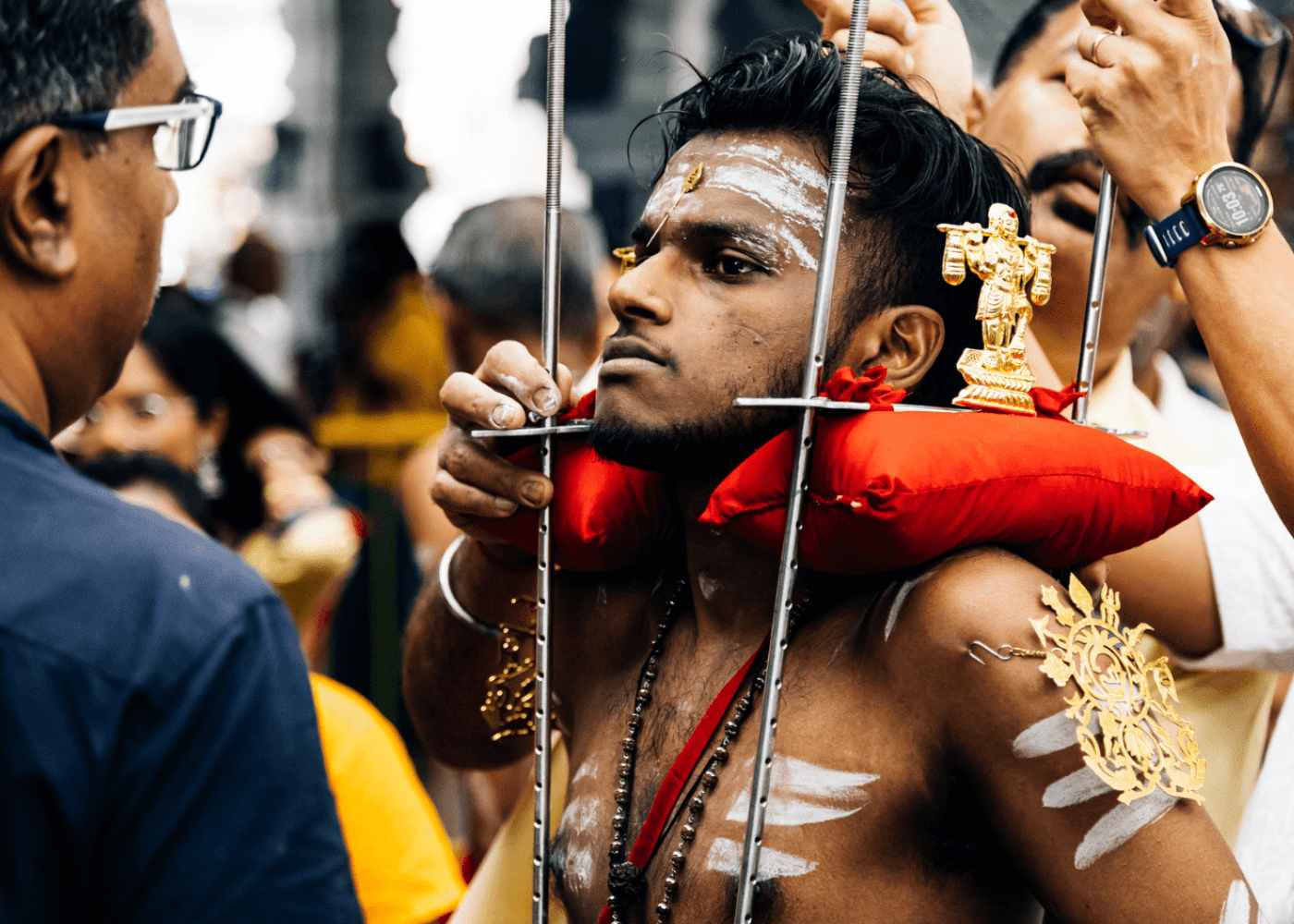
One of the most popular practices is the Kavadi Aattam (translates as Burden Dance), a ceremonial act carrying physical burdens as a form of spiritual dedication. Participants may carry offerings such as paal kudams or milk pots, symbolising purity and devotion. Some devotees also engage in symbolic acts of self-discipline and commitment, such as piercing the skin, tongue, or cheeks with vel skewers.
Preparation for Thaipusam involves a great deal of care and reverence. Devotees cleanse themselves spiritually and physically by maintaining a vegetarian diet, fasting, and observing celibacy. Prayers and meditation are central to the process, fostering a sense of mindfulness and inner peace. Want to learn more about the devotee’s journey to carrying a kavadi? Find out here.

One of the highlights of Thaipusam is the live music that accompanies the procession. Playing traditional instruments, musicians line the route, adding to the festive and spiritual atmosphere. The music starts early (around 7am) until 10pm. If you join in as a spectator, look out for singers and percussionists who travel with the devotees as a form of encouragement as they carry on the journey. Another key ritual of Thaipusam is head shaving, which symbolises purification. Devotees often shave their heads as an offering to Lord Murugan and take a ritual bath before continuing their journey to the temple.
That’s not all! The festival is celebrated enthusiastically globally, especially in regions with Tamil communities. It is widely observed in India, Sri Lanka, Southeast Asia, Malaysia, Singapore, and Indonesia. The festival is also marked in countries with significant Tamil diaspora, such as Fiji, Mauritius, Seychelles, South Africa, Canada, and beyond. It is recognised as a public holiday in some regions, including Mauritius, parts of Malaysia, and Tamil Nadu in India.
How you and your family can join the Thaipusam celebrations in Singapore

The main action will unfold along a four-kilometre route between the Sri Srinivasa Perumal Temple on Serangoon Road and the Sri Thendayuthapani Temple on Tank Road. Thousands of Hindu devotees will walk this route, carrying offerings like the paal kudam or the kavadi.
The procession begins on 31 January 2026 at 11.30pm from the Sri Srinivasa Perumal Temple. The doors of Sri Thendayuthapani Temple will open on 1 February 2026 at 12.05am. If you want to glimpse this unique celebration, it’s best to station yourself along the procession route as early as possible.
Otherwise, catch the Silver Chariot Procession on the eve of Thaipusam. It is said Lord Murugan leaves Sri Thendayuthapani Temple to spend a day with his brother, Lord Ganesha or Sri Vinayagar. The 2026 Silver Chariot Procession will start at 5am, making a stop at Sri Mariamman Temple at South Bridge Road at 6.30am, before arriving at at the Sri Layan Sithi Vinayagar Temple along Keong Saik Road at 7.30am. If these timings are too early, head for the return procession which begins at 5pm from Keong Saik Road, with multiple stops at Cecil Street, Chin Swee Road, and High Street, before returning to the Sri Thendayuthapani Temple at 9pm.
If you’re participating as a devotee, take note of the important timings and make your bookings for the rituals. All information for devotees can be found here.
If you plan to witness Thaipusam, remember that this is a sacred occasion, so being respectful and mindful of the devotees’ focus during their spiritual acts is essential. Follow the official Thaipusam page for up-to-date information.
Key locations for Thaipusam 2026:
Sri Srinivasa Perumal Temple, 397 Serangoon Rd, Singapore 218123
Sri Thendayuthapani Temple, 15 Tank Rd, Singapore 238065
Sri Layan Sithi Vinayagar Temple, 73 Keong Saik Rd., Singapore 089167
Road closures for Thaipusam: LTA (2026 road closure information has not been updated at this point of writing)
References:
roots.gov.sg
Indian Heritage Centre
Wishing all devotees a beautiful journey on Thaipusam 2026!
This article was originally written by Jay Panicker in 2025 and updated by Andrina Loo in 2026.