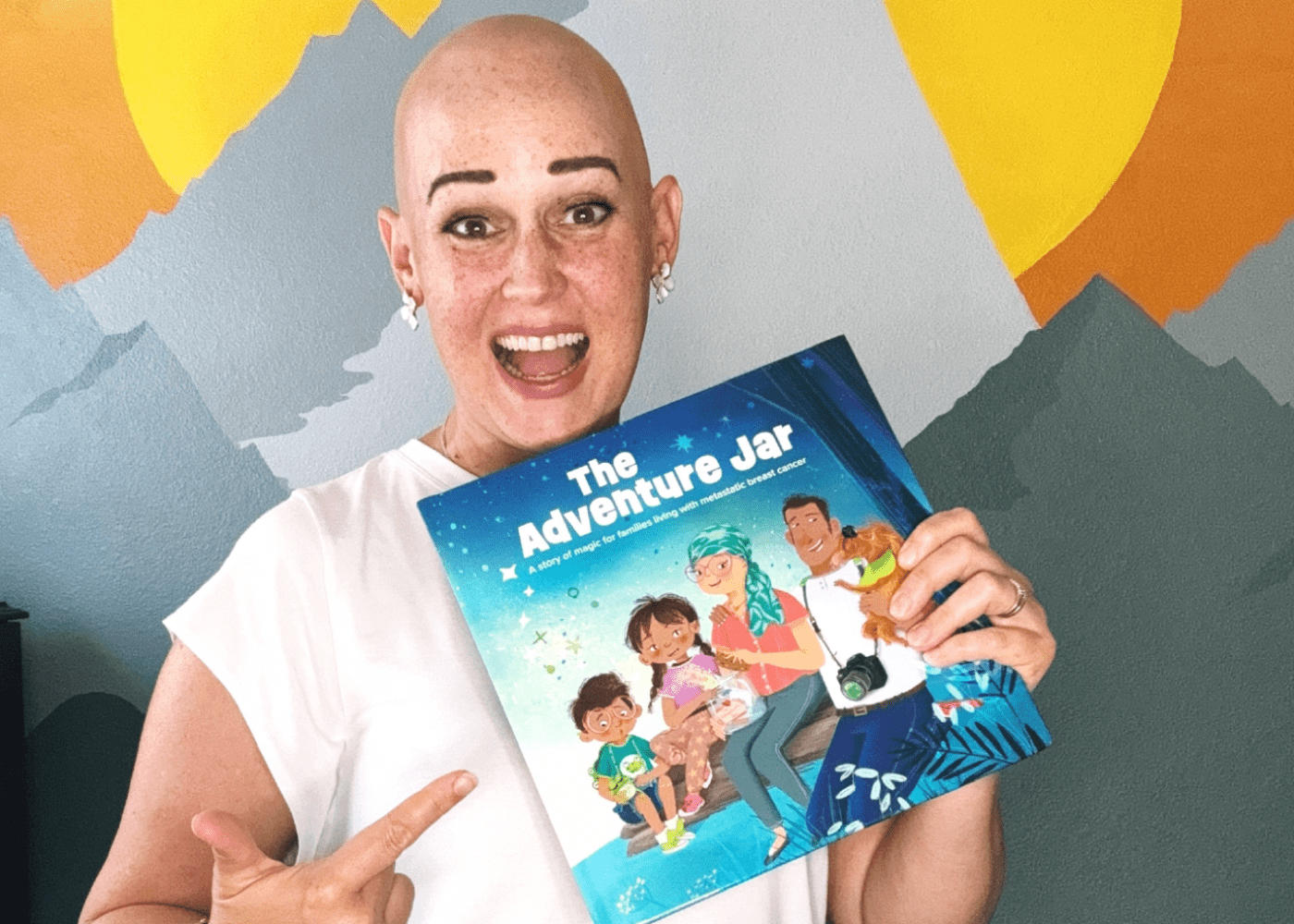
The Adventure Jar is not your average bedtime story. This heartwarming book is an important (and free) resource for families dealing with cancer - here's how it came about, and where to find it.
Cancer. It’s a diagnosis that can cause fear and anxiety not just for the patient, but for everyone who cares for that person. It’s a struggle to navigate a cancer diagnosis as an adult, but what about when young children are involved? Enter this amazing new children’s story, The Adventure Jar, designed by cancer survivors to support other families who are going through it.
This free resource from the breast cancer foundation gently addresses the reality of living with a parent going through cancer treatment, and shifts the focus from the all-consuming disease to a positive mindset. We asked one of the co-authors, Lauren Huffmaster, and a patient who received the story, Connie Seng, about the significance of this book for kids and families.
1. Thank you for sharing your story with us today, Lauren. Can you share a little about your personal journey with breast cancer, and what inspired you to co-author The Adventure Jar?
“I was diagnosed with metastatic, or stage four, breast cancer at the age of 37 years old. When I was diagnosed, my initial burden was for my family. I was heartbroken, and most of my thoughts swirled around how my disease was going to change the lives of my children, who were only 2, 4, and 6 years old.
I knew there was no way to escape cancer’s impact on their lives, but I hoped this impact could shape them into resilient women. So I dedicated myself to reframing our circumstances to ensure our identity as a family actually became stronger because of this disease. The Adventure Jar is a story that demonstrates how a mindset shift can create opportunities within family relationships, even in difficult circumstances.”
2. How did the idea for The Adventure Jar come about, and what do you hope it offers to families in Singapore?
“When I was diagnosed, I needed to learn how to parent through cancer and to find tools for teaching my children how to face the uncertainty of this disease. So I looked for books and resources that depicted cancer’s impact on families, but never found a book that provided the kind of support I wanted. So I was thrilled when Gilead Sciences invited me to participate in a children’s book project. I collaborated with eight other women from diverse backgrounds to create The Adventure Jar, a resource that will encourage children like mine.
I hope this book makes children who are witnessing a parent with metastatic breast cancer feel seen and acknowledged. I also hope this book provides the women living with this disease a reminder that the adventures of life are not over. Our days may look differently than we hoped, but we can create magic in our relationships.”
3. The story is told through the eyes of a child. Why was it important to take that perspective, and how do you think it helps young readers process complex emotions?

“As an advocate, I work to acknowledge that it is not only the patient who is experiencing the emotional toll of cancer. The co-survivors, those living in the home, are also experiencing cancer daily. However, these individuals are rarely acknowledged. The Adventure Jar tells this aspect of life perfectly! It recognises how the mother’s disease requires everyone in the family to face unexpected changes, uncertainty, and disappointment.
This book beautifully features the daughter as a role model for the family. At the beginning, we see her hiding a little and feeling sad because of her uncertainty, but by the end, she is looking at life with hopeful expectation.
As she shifts her mindset to see the good, even in these difficult moments, she also changes the family’s perspective. This transformation in the daughter is a wonderful reminder to anyone facing hardship that a shift in perspective can reshape an entire experience.”
4. What was the most emotional or meaningful part of the writing process for you?

“For me, all writing is deeply personal and emotional. As a society we have become very familiar with what cancer looks like, but have not even begun to scratch the surface on what cancer feels like. So I have made it my life’s work to dig into the hurting places of my own cancer experience and find words and metaphors that accurately demonstrate what these spaces feel like in a patient or survivor.
When I saw the illustrations of The Adventure Jar for the first time, I cried at how the daughter was consumed by her concern for her mother. The daughter couldn’t enjoy the first adventure because she was busy protecting her mother by redirecting the younger brother and analysing her mom’s strength, rather than enjoying the exhibits.
This part of the story feels so real. My oldest daughter continues to make decisions for herself and others based on how she thinks I am feeling, and she has done this for most of her life. Then, like the mother in the story, I respond by giving my girls lots of adventures. Sometimes, I might be accused of going overboard, but I realise that they need escapes to help balance the emotional burdens they carry.”
5. In many families, topics like illness and death are often not openly discussed. What are your thoughts on this cultural silence, and how does the book help break it?
“I think society is not comfortable with weaknesses of any kind, silence around illness is only one example of this. Chronic illness is not a stagnant experience. As we see in the book, there are good days and bad days, and these can be unpredictable.
When we only depict women with MBC as sad and bald we really aren’t telling the whole story.
Often the uncomfortable moments coexist with the beautiful ones. This book shines a light on the overlapping good and bad moments. This helps reassure the children that they are not stuck in one way of being and by simply playing an imaginative game they can reshape their circumstance.
The Adventure Jar also gives us an opportunity to tell young children they are not alone. When they see a family like theirs in a book it means someone understands how it feels. This feeling of belonging is extremely important for children, and really, it is important for all of us.”
6. How can storytelling and children’s books like The Adventure Jar support emotional literacy in young children, especially in the face of uncertainty or grief?
“First, I hope The Adventure Jar encourages the mothers living with MBC to never stop looking for the magic in their relationships. Our days may not look like what we envisioned, but there is beauty available if we shift our perspective and embrace the joy of being together. Only when we learn to shift our mindset can we teach our children these tools of resilience.
This book also gives families a discussion starter, because we can pause while reading the story and ask our children, “Have you ever had a moment when you felt like this?” It is an unabrasive way to check in with our children and see where their thoughts are.
Similarly, a mother can use the book to help her children understand her needs. She can say, “This is a hard moment for me, how do you think I can find the magic right now?” Because of the Adventure Jar, everyone in the family will know what she is thinking, and can come together to shift their mindsets and support her.”
7. What advice would you give to parents in Singapore who are facing a diagnosis and don’t know how to begin talking to their children?
“One thing I’ve learned is my children are never thinking what I’m thinking. Over the years, I’ve asked my girls if they have any questions about my treatments or disease. This way I get to hear the questions that are rolling around in their mind. This has been a great tool for me. More often than not, the questions they ask are very different from the questions that concern me and often, I am taken aback by the simplicity of their concerns.
Additionally, it has been essential that my children know I will honestly answer any questions they ask. This allows our relationship to stay strong and they know they can trust me and that I respect their role in my life. I know there will be times when they have difficulties and I want them to be able to bring their stories to me. Without a relationship built on honesty this cannot happen.”
8. Are there any particular reactions or moments with young readers that have stood out to you since the book’s launch?
“While we wrote this book for the metastatic community, it’s been surprising how many families, not facing chronic illness, have reached out for it. I personally distributed the book to multiple school libraries as a tool for teachers to use to teach empathy and understanding.
Many families have let me know the book is in their regular rotation for nighttime reading. I think this demonstrates that we successfully balanced the message with an imaginative, childlike perspective. Of course, the cute dog doesn’t hurt either. I hope anyone living with metastatic breast cancer will download The Adventure Jar in English or Chinese for free.
Connie Seng was diagnosed with cancer before her son’s first birthday. Here, she shares her experiences and what The Adventure Jar means to her.
1. Thank you for your time today Connie. Can you share your family’s experience receiving and reading The Adventure Jar?
“When we first received The Adventure Jar, I wasn’t sure what it would be like but the graphics caught my son’s attention immediately. He got excited and eagerly asked me to read it with him. I first wondered how he would react to it, and also if the book would be brutally honest about the impact of cancer.
However, my worries went away as we started reading. The Adventure Jar was able to bring up the topic in a gentle way, addressing the impact of a parent diagnosed with cancer. It even turned it into a way to have an adventure as a family. This actually gave me good ideas on creating our own adventure jar to explore!
It created an opportunity for us to have honest conversations about the illness, and encouraged us to look for ways to make it fun and exciting. The BCF also helps to create experiences for us as families, and my son looks forward to the Pink Walk every year as part of our adventure!
2. What impact did the book have on your child’s understanding or emotional response?
“When we first told my child about cancer, it was tough explaining it to him as there were no age-appropriate resources about cancer for a kid his age. We could only tell him about it briefly, and naturally, he didn’t quite understand what it was.
Having a book like this helps him to see that we aren’t the only family dealing with the same situations and there are others like us. It also shows him that we need to be brave and fight illness as a family together, and create new memories and experiences.”
3. Why do you think resources like this are so important for families navigating illness, especially in Singapore?
“I was diagnosed within a year of the birth of my child, so he had a mum that has had cancer ever since his first birthday. This is why screening is important during pregnancy and after birth of a child, as the cancer tends to be more aggressive in young women at this stage, as hormones can greatly impact the body.
Increasingly, young ladies are diagnosed with cancer. Thus, when they have young children, resources in pre-schools can be limited. When a parent gets diagnosed, the whole family is affected, and so are the children’s childhood experience. Things like excursions and family activities take a backseat while Mum and Dad navigate treatment, and children struggle to understand why sometimes.
Resources like The Adventure Jar gently approach the topic, guiding them to understand what Mum and Dad are dealing with is important, so they can understand that it isn’t their fault, Mum and Dad doesn’t love them less, and the family is still the same, just with another battle to fight together. TAJ can be an important resource as it can also encourage parents to look for ways to make the cancer journey more exciting and to let children be involved in the journey.”
4. How has it changed the way your family talks about cancer or other difficult topics?
“It has sparked the idea for us to create our own adventure jar and to embark on our own family adventures. As we think of activities to do, we start to include our child more, instead of just putting everything aside and dealing with it on our own.
This opens up a window for us to talk through the hard conversations and as we have more of them, it gets easier to bring up. Kids are smarter than we think, and including them as an important member of the family makes them feel good and not left out.”
The Breast Cancer Foundation partnered with Gilead Sciences on this project. Mae Pang shares why The Adventure Jar is having such a huge impact.
1. Mae, why was it important for the Breast Cancer Foundation to support a children’s storybook like The Adventure Jar?
“In a survey we did with Gilead on the Impact of Parental Cancer on Children in Singapore, we found that even though 61% of respondents had recovered, they had high practical and emotional needs, the latter of which ranked the highest among those surveyed.
Only 20% reported minimal signs of distress in their children, and nearly 40% of them rated communication as difficult, with a rating of 4 to 5 out of 5.
On that note, Breast Cancer Foundation aims to provide support to the breast cancer community, be it breast cancer patients, survivors or caregivers. The Adventure Jar book portrays the challenges that many families face when their lives are disrupted by cancer. Amid the treatments and uncertainties, this book becomes more than a story – it’s a bridge for conversations between a mum with breast cancer and her young children, helping to heal and connect.”
2. How have Singaporean families responded to the book so far?
“During our book launch in July, we held an event for families with young children to experience the book through puppet shows and craft workshops. The children did enjoy the book and played along with the puppets.
When it came time for them to create Adventure Jars with their parents and siblings, many of them were able to understand the concept of creating cherished memories and having shared goals.
Our members who have read the book to their children shared that it resonated deeply. Their little ones could relate to the experiences, reflecting what they felt during their mum’s cancer journey. By opening up these conversations, the book has helped mums understand the emotions their children experience and better strengthen their bond during this challenging time.”
3. Are there any future plans to integrate the book into schools, counselling services, or hospitals?
“We’ve intentionally chosen not to sell the book because we believe that resources like The Adventure Jar should be freely available to the people who need them most. The focus is on democratising access, ensuring that every family facing breast cancer, regardless of income or background, has support tools at their fingertips.
We are currently exploring ways to integrate the book into schools in Singapore, so that emotional literacy and open conversations around illness can start early, in a safe and familiar environment. We hope that this resource will eventually support not just families, but also teachers, counsellors, and social workers engaging with children affected by illness in their communities.
We will be distributing physical copies of The Adventure Jar to key public institutions, including public libraries, restructured hospitals, selected clinics, and private healthcare providers. These placements are strategic: we want the book to be available at natural points of care and support, where patients and families are already seeking help.”
Download The Adventure Jar for free, and reach out if you or your family need support.