Your career gap and being a stay-at home mum is a choice. So are the consequences. Let's talk about both.
I love stay-at-home mums. I also think women should never stop working. Before you close this tab… I need a minute.
Not because I think careers are more important than children. Definitely not because ambition is a personality. But because the world does not hold still while you’re on the school run, and nobody at playgroup is going to tell you that. They’re too busy asking whether you’re breastfeeding and judging your answer either way.
My own mother was a stay-at-home mum. Extraordinary at it. She kept a home so organised she located my teen lock-and-key journal within four minutes of it existing. What she didn’t plan for was what came after: the quiet identity crisis of a woman who had poured everything into her family, unsure who she was when we stopped needing her quite so urgently. And then when my father died. The silence that followed was deafening in ways I don’t think any of us were prepared for.
That image has never left me.
What a year off taught me
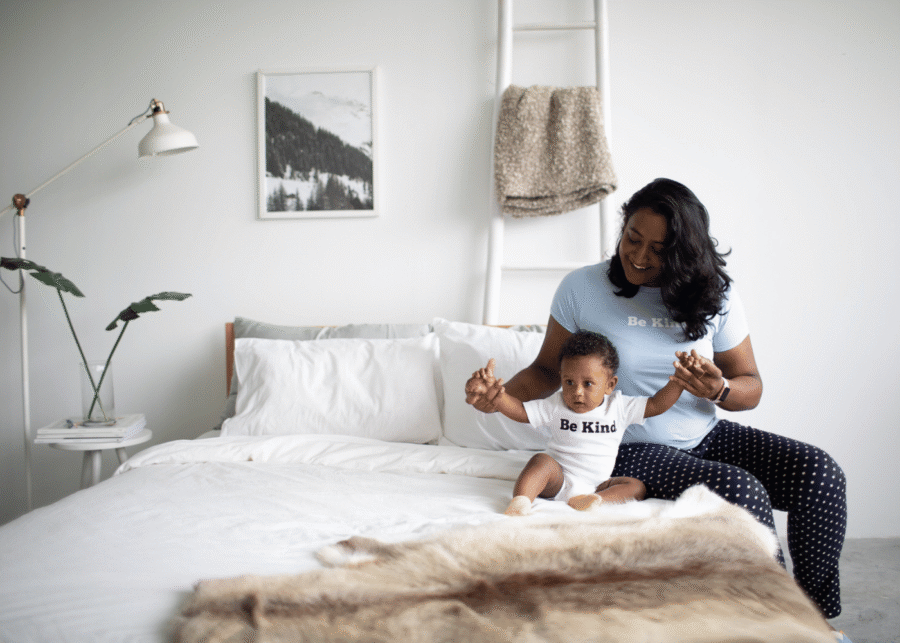
When my son was born almost nine years ago, I took a year away from full-time work. Best decision I ever made: the slow mornings, the absence of a calendar, being entirely present for a small person who needed me for everything, including emotional support during particularly upsetting episodes of Sesame Street when we were acquainted with Rocco. That rock had more audacity than most people I’ve worked with.
But I also freelanced. I know this privilege doesn’t come with a lot of careers, and I acknowledge it completely. I worked with my son napping next to me. Not because I couldn’t switch off, but because even in my sleep-deprived, breast-milk-crusted-on-my-nursing-bra state, I understood: the woman I was before my son arrived was worth preserving. She had opinions and a career and a LinkedIn that didn’t list “kept a human alive” as a core competency. She deserved to still exist.
Re-entry is harder than anyone tells you

The working world does not pause for you. It accelerates. The gap between where you left and where everyone else has moved widens quietly, rather than all at once. And in case you were wondering: this is so even more so now than ever. History has repeated itself and what happened during the Industrial Revolution is happening in 2.0 — except this time with several wars, a cost-of-living crisis, questionable human behaviour across the board, and a millennial midlife reckoning happening simultaneously.
In the midst of all that, I’ve watched brilliant women take five or six years away and return to a workforce that reorganised entirely while they were gone. One friend recently asked me what Notion was. Another didn’t know that LinkedIn now functions as a content platform where your professional visibility depends on how well you can write quasi-inspirational posts dressed up as career milestones.
These are not small things. These are the invisible entry requirements nobody mentions until you’re already on the outside, pressing your face against the glass.
And it’s not just professional. Research published in a peer-reviewed systematic review found that lack of employment-linked mental activity may place non-working middle-aged women at greater risk of cognitive decline. Women make up the majority of dementia cases worldwide. Paid work, with its demands for problem-solving, social interaction, and continuous learning — appears to be genuinely protective for the brain.
Staying sharp is not ambition. It’s maintenance. Your brain, like your professional network, does not wait patiently for you to return. Same energy as a group chat you went quiet in for six months, except the group chat didn’t move on and hire someone else.
Why financial independence is non-negotiable
Financial dependence is a vulnerability. Not a judgment, a fact.
Marriages end. Partners get sick. Industries collapse. I have been laid off five times across a career spanning Singapore and the US. Five times. I have watched the world fail to hold still for anyone, least of all women who are somehow still remembering to pack newspaper for papier-mâché day while quietly keeping everything from falling apart.
A woman who has been out of the workforce for five or more years — skills atrophied, CV gap scrutinised by people who have never once taken a career break to raise a human — is in a structurally weaker position than when she left. This is not an opinion: it is arithmetic with feelings.
I have a friend, sharp as anyone I know, who spent seven years as a full-time mother and is now navigating a divorce while trying to re-enter the workforce simultaneously. She’s doing it, because she is formidable. But she has told me more than once: do not let your financial identity dissolve into someone else’s income. Not because love isn’t real. Because life is long and unpredictable and you deserve to always have a door you can walk through on your own.
Economic independence is a form of safety. Feminism has been saying this for sixty years. We keep needing the reminder because we keep being told it’s unromantic to bring it up. It is not unromantic. It is the most loving thing you can do for your future self.
The question nobody gives you permission to ask
Underneath the economics and the brain science, there’s a bigger question: who are you when nobody needs you?
Not who you are as a mother. Not who you are as the person who remembers everyone’s allergies and sends the birthday cards on time. Who are you? What do you want from this one life that has absolutely nothing to do with the people you are raising?
Most women have never been given permission to ask this. We are socialised to locate ambition through our children’s achievements, our relationships, the fridge that is always stocked. And then one day the children leave, or life changes shape, and you find yourself alone with your thoughts for the first time in years. And the thoughts are mostly, “Who even am I though?”
Your ambitions do not have to be enormous. A language, a creative practice you abandoned in your twenties when Real Life showed up uninvited. Something that is entirely, unapologetically yours. But they have to exist. Because a woman who knows what she wants beyond her children is not less of a mother. She is, more often than not, a sharper, more grounded, more interesting one.
So take the break, take a sabbatical but come back to you, even if it’s part time. Take care of you, too.
Nobody lies on their deathbed wishing they’d been more useful. They lie there thinking about what they didn’t let themselves do.
Don’t be that woman. She sounds exhausted and a little resentful and honestly, she deserves so much better. Stay in the work. Stay in yourself. Know exactly what would break your heart if you left it undone.
And in case you need the reminder: you’re a bad b*tch. You can do this.